
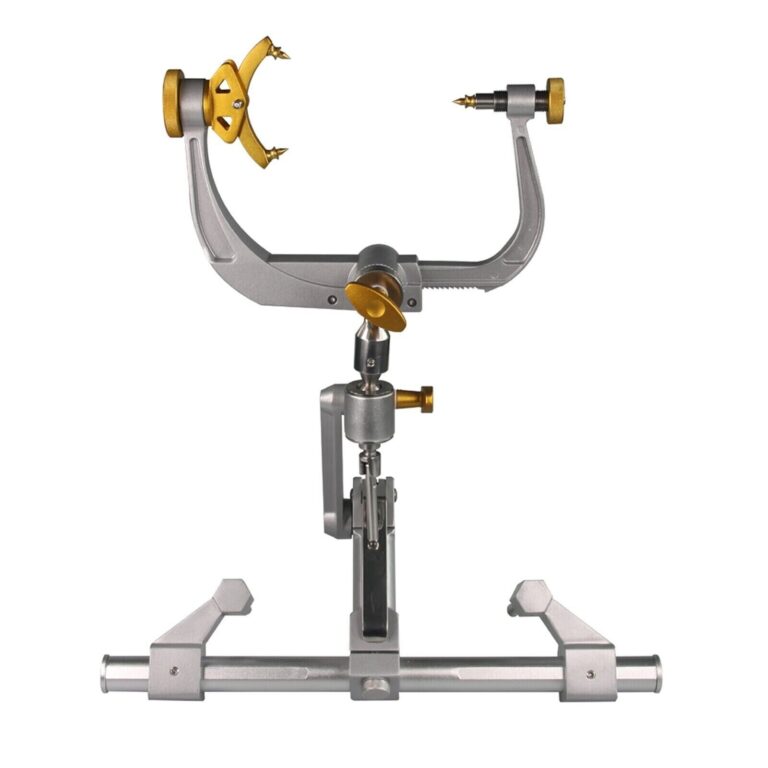
(Trigger warning: this page contains references to Brain Tumours and Brain Surgery which some may find distressing)
This blog started in the middle of February 2024 and is actually the longest out of office you are likely to ever read. You see, in August 2024 I wasn’t diagnosed with a brain tumour. More on that in a minute.
In August 2024 I made a pilgrimage from Cornwall, the place where my dad died a number of years ago (up until this point probably one of my most significant life events) to London and back again in one day.
The reason for this pilgrimage? Was the aforementioned non diagnosis of a brain tumour.
You see since February I had been experiencing escalating headaches, dizziness, lack of co-ordination and general clumsiness. I had been to my GP on a number of occasions and they had worked on the assumption they were migraines, and with input from my wife had also thought it may be some kind of bowel issue, so I had an urgent colonoscopy, followed by an urgent MRI that confirmed everyone literally had the wrong end of the stick!!!
In fact getting past the GP wall was quite tricky. I made numerous GP appointments, I knew something was wrong and I could not get anyone else to see this. You have to just keep persevering, make another GP appointment and then another – eventually someone will do something.
What you may wish to consider is Private Medical Insurance. When you think of this you may think of it paying for you to have private hospital care, however policies these days have many added little extras. My policy for example, with WPA, has something called “remote GP”, which enabled me to have either a telephone or video appointment with another GP for a second opinion. This GP suggested I be referred to a neurologist and this suggested referral was then sent to my GP. I then had the choice to either claim for that privately or my GP could arrange it. This did 2 things for me;
- – proved to me that I was not being a hypochondriac
- – meant that my GP seemed to start taking the issues a little more seriously when I made another appointment – they finally referred me for an urgent MRI and I didn’t need to claim in the end.
https://www.wpa.org.uk/healthcare-partner?link=matttrapnell
I should say, once I had been referred for the MRI and they found something, everything moved at an incredible pace that I really cannot fault in any way.
I went from non-diagnosis to brain surgery in the space of 2 weeks, incredible really!
The first thing I properly knew about my diagnosis was after the MRI. A phone call from a doctor who specialises in brains, telling me they didn’t like to do this kind of thing over the phone but they had found a lesion on my brain and they needed to see me urgently – and if I started being sick I needed to go to A&E immediately.
The lesion was blocking the spinal fluid from getting back out of my head, so what I called “the really bad headache” (where it felt like someone was pumping my head full of air, my tinnitus would throb and my vision double) was my head filling with spinal fluid. It made sense as soon as I was told and needless to say this was not a good thing – hence the call.
The reason I said non diagnosis earlier is that if you want answers and facts don’t get a brain tumour – you won’t get many, certainly not straight away!
It turns out neurologists know thousands of different ways to arrange approximately 100 different words into the meaning “We don’t actually know”.
I get it, I really do. Essentially until you can have a look at it you don’t know what it is. This is where the phrase “working diagnosis” comes in – I got used to this terminology. Working diagnosis is basically doctor speak for “We don’t know what it is, but we think it is this”, and they say working diagnosis because to know what it is, they need to test it, which means brain surgery, something called a resection. Which is not moving it so it can hang out with its brain tumour friends – a resection is removal and testing it and that ultimately means removal of my scalp and part of my skull (called a craniotomy), so they can remove the not so little fella!
I say not so little fella as Terry the tumour was 5.2 centimetres big, and had moved parts of my brain by 13mm – so he was a bit of a weighty turd.
I should mention at this point that I named him Terry, as when I received my working diagnosis everybody went out of their way to avoid the word tumour, although it became apparent that is exactly what it was, and they sent me a letter advising that it was likely one of two different types, neither of which I could pronounce so I decided to name him Terry the Tumour. Primarily just because I like a little bit of alliteration. A happy biproduct of this, was that it enabled myself and my wife to talk about Terry, with family and friends without the weighty connation’s, which ultimately is why medical professionals were avoiding the word, in particular to talk about it in front of the children without them knowing what we were alluding to. It certainly worked for a period anyway, the trouble is children aren’t stupid and eventually they managed to put two and two together and we had to explain exactly what was happening.
Long story short. My working diagnosis was good, it was likely one of two types of tumours, both of which are benign, so any surgery I would have would likely be curative. In fact, to quote my neurosurgeon, if you’re going to get a brain tumour, this is the one to get. So, in actuality, I’m pretty damn lucky – which I don’t think someone with a brain tumour would often say. All I need to do is survive someone having a rummage in my brain… easy!
(Post – op ed – the tumour was confirmed as a subependymoma and as such a grade 1 tumor and benign, I truly am incredibly lucky.)
The particular issue though, is that the not so little fella was in the right lateral ventricle of my brain (the fluid in the centre of your brain). So he was a bit of a tricky big man to get to. Another issue is that, due to his size, they couldn’t just remove him without my brain freaking out even more.
The solution? To fill my head with saline and, during surgery, fit a drain to my brain that can slowly remove the saline over time – giving my brain time to adjust to the fact that Terry was no longer knocking about!
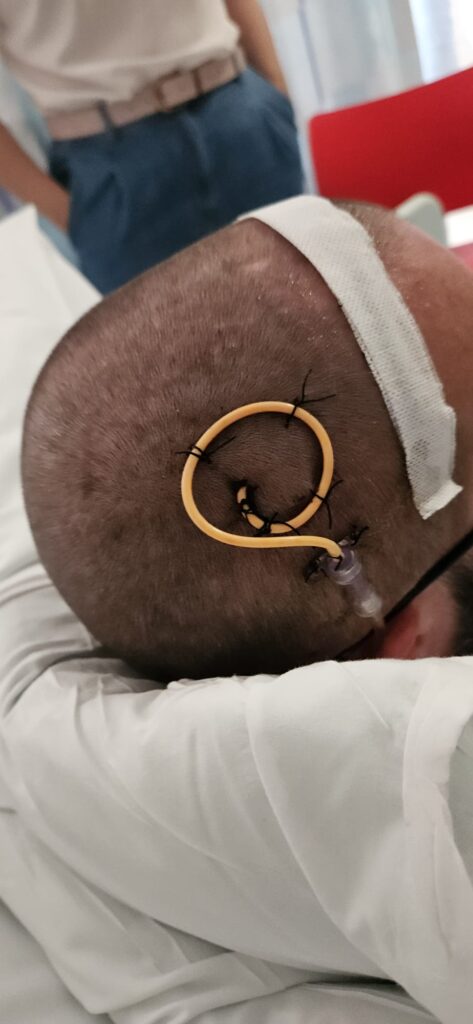
Brain drain (not the type I normally get!)
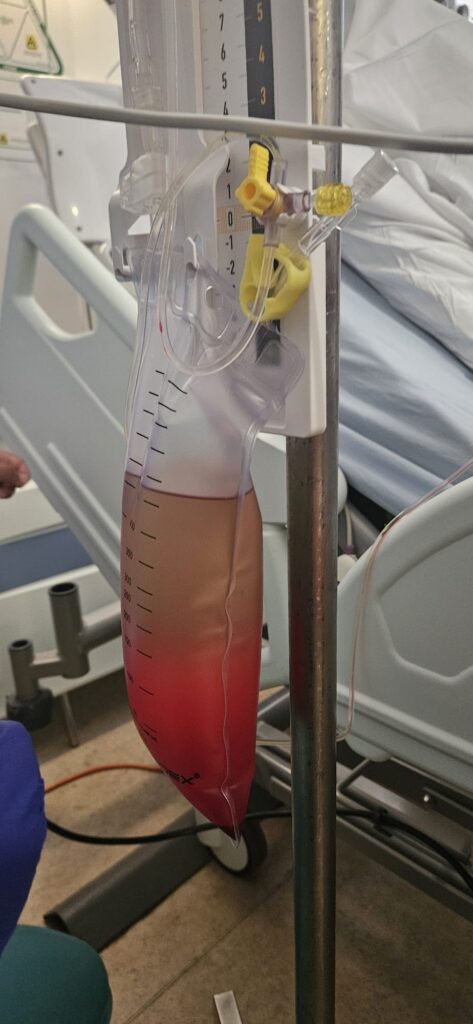
What the brain drain filtered out – tequila sunrise anyone? We named this “terry juice” – I might invent my own cocktail!!
I would have loved to have been in the meeting when some very clever doctor floated (literally) that idea as a solution to the problem. My takeaway from this – no such thing as a bad idea!!!
In fact one of the hardest parts of not being diagnosed with a brain tumour is telling people;
- – because, due to the non-diagnosis, you don’t actually have anything tangible to tell anyone “there is a lesion on my brain”, what does that actually mean? – it happened to me and I am still not entirely sure.
- – I hate making people feel bad, which is exactly what you are doing, it goes something like this…
When you start a conversation one party will invariably say “How are you?”
I have been answering that question with “are you sure you want to know the answer to that question?”
They invariably reply saying something like “that sounds interesting, go on….”
The answer to that question has been, “well – I have got a brain tumour”.
There is then normally a bit of a pregnant pause , followed by an expletive – let me know if you want to know the expletive of choice in this scenario – but it rhymes with duck!
I then, in my people pleasing manner fast forward to the good news, which in a nutshell is what I have just explained – surgery – should be curative as tumour is likely benign, so everyone can feel a bit better, and we can all move on to a different, less weighty, subject.
When I Undertake an Estate Planning Consultation I tell people “I specialise in the bad stuff”, well I now I think I have properly qualified… not sure what letters after my name this one gives me?
So, what you are now reading is one of the most personal blogs I ever have or ever will write.
Hopefully you can stick with it, try not to look away, I am covering all sorts of bad stuff in this one!
You must be wondering about the odd title for this Blog? Originally it was going to be called something else entirely, but the title was a little too dark, even for me.
When I had my non-diagnosis, we went on our family holiday to Cornwall ( hence the previously mentioned pilgrimage) so as to not disrupt the summer holidays as much as possible for the children, we figured life might become hard enough as it was without also cutting their holiday short.
What I found was I would be doing something, like walking the coastal path, and randomly think “I’ve got a brain tumour”.
I also did a bit of very bad surfing. Whilst doing this, I would have similar thoughts – I wonder how many people have surfed with a brain tumour? – hence the name of the blog. I can confirm that it does not help with the pop up. In fact I have now both surfed and snowboarded with a brain tumour and have found no tangible benefits for either – other than falling over a lot!
So, what have I learned?
First, neurosurgeons are very clever. It really is the stuff of science fiction, I refer you to the solution regarding removing the tumour, and the saline and drain installed into my head. Did you know there is also a sort of satnav for your brain called Stealth, basically a brain navigator? Of course you didn’t, why would you? This enables neurosurgeons to successfully navigate through your brain.
However, no matter how clever a neurosurgeon is, you should still be prepared for the unexplainable. After my operation I was paralysed on the left side – something no one could explain the reason for as the operation had gone well. I personally think it was my brain going “what the hell have you been doing to me?”. Luckily I knew very little about this until after the operation, as I was still off my face on the myriad of drugs still in my system. It was after the operation, when everyone was making me concentrate on my left side that it became clear I had scared the living daylights out of everyone – including the neurosurgeon. This could also account for my ongoing left side issue I mention later.
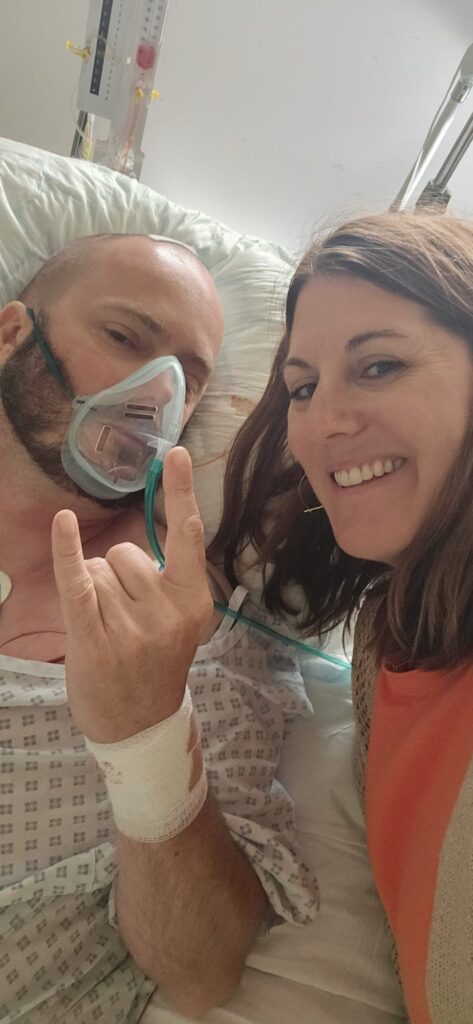
I know nothing about this picture – apparently it is in intensive care – I am off my face, so don’t remember it, and that could be why I think I am some kind of rockstar – this is with my left hand, so I don’t know what all the fuss was about!!
There is also a reason we have the saying “patience of a saint”. The nursing staff really do have the patience of a saint and there are actual angels walking the corridors of Saint George’s Hospital. From personal experience I know that brain injured patients can be “difficult” (just speak to my occupational therapists, more on that later) and the patience required to help them help themselves is immeasurable – perhaps that is why we are called patients?
Be mindful of other people’s journeys, you never know who you might meet, whose journey is following a similar path and how they might inadvertently help your journey, or when you might meet them and how they might help.
They may be on the other side of a green curtain.
The man in the cubicle next to me. Had an aneurysm resected and it meant that the blood was being diverted from his brain stem down the back of his throat, resulting in the whooping cough he had picked up causing him to black out every time he coughed. Ultimately the resection had not worked, and he received the worst news you could get, he was told he would likely need a further operation from which he may not wake from. I listened to this, and then heard him deliver this news to everybody he loved.
Even when you are going through the worst thing imaginable, there is someone going through something much worse, and the strength and grace this person had was truly inspiring to me and helped me deal with my situation no end.
Lesson – perspective is really important. In fact his diagnosis was possibly as difficult, if not more so, than my own. I am not ashamed to say I shed a tear for this amazing man and his family. In fact, he was one of many people on the other side of a green curtain dealing with very difficult circumstances with grace, humour, humility and quite often extraordinarily good home cooked curry (thanks to the wife’s of some of the patients – it was delicious!)
I am going to let you in on the very worst thing I know for certain about you.
You are going to die!
Not pass away.
Not pass on.
Not pop your clogs.
Not kick the bucket.
But die – leave everything you know and love behind.
If we know this fact, why don’t we prepare for it both practically and emotionally.
Simple things can be done relatively easily.
Write your Will.
Write your LPA’s.
Plan your funeral (as opposed to leaving that highly emotional task to someone else who will likely be grieving) – I remember really struggling to choose songs for my dad’s funeral. So much so, prior to my surgery, I would go for a run, listening to my playlists trying to choose the songs that would be played at mine. A rather emotional task that is quite hard and I struggled to narrow them down, as I have still not settled on them. My funeral might just end up being a gathering of people listening to a load of my favourite songs!!!
Emotionally prepare – there is some great reading for you out there.
We prepare incredibly well for the imminent arrival of life but not the inevitable loss of death…. why?
There is a great book, by Kathryn Mannix, called “With the end in mind” that I think everyone should read – that talks about exactly this.
https://uk.bookshop.org/a/14644/9780008210915
Having lost friends and family, and having grieved for them, one of the things I first noted about my non-diagnosis is that I started essentially grieving for myself. Which is both odd and incredibly self-absorbing.
The surprises – stuff I hadn’t thought about!
The biggest one – I seriously underestimated brain surgery.
I used to train people who advised on protection products – Life Insurance, Critical Illness – that sort of thing, and I used to talk about the fact that everyone has a “superman syndrome”, essentially , none of the bad stuff will ever happen to them – people just don’t want to think about that type of thing – and I said that their job was to make them truly think about what their life would look like if any number of bad things were to happen, from a financial perspective.
Well, I can tell you, although I had arranged Critical Illness cover, which should relieve some of the financial pressures on my family and I whilst I recover, I suggest you do the same – and make sure you seek advice, as you will need someone to probe you due to “superman syndrome” dictating that you may not give it as much thought as it deserves. I got to experience superman syndrome first hand in regard to the surgery I required. I backed myself to handle it with no problems, but it turns out I am not the superman I thought I was.
It is pretty significant, and a different Gareth has woken up from the operation, not the Italian speaking model I had hoped I would be, but I figure I could still learn Italian and dye what little hair I have left black.

Not quite an Italian supermodel – more Frankenstein’s monster – hairs a little long but I struggled to shave my head for some reason!

What goes in, must come out!! – I’ve kept these staples, let me know what you think I should do with them?
Occupational Health would visit me in hospital at around 11am each day and try to get me to act like a normal human being, something I had never been good at in the first place and something that I invariably failed at and would, unfortunately, take out on them – not some of my finest moments! It made me realise the effects the surgery had on me – just getting out of bed and walking was tricky – again they were brilliant with me and incredibly patient, unlike me.
There were several tasks they would make me complete – walking was one – harder than it sounds after brain surgery, made even more tricky by my left sided temporary paralysis. I thought I may be destined to walk in circles for the rest of my life!
I also had to draw pictures of clocks – which signifies the brains ability to plan. I did not do very well at this task and was kicking myself as I knew about this, it is in a great film I have watched called “The Crash Reel” – about the traumatic brain injury (TBI) of snowboarder Kevin Pearce – absolutely worth a watch if you can.
They also made me undertake an exercise, basically having to cross back through several lines – by some kind of wizardry this highlighted that my brain was ignoring my left side, so I would need to pay attention to this side from now on. It’s odd when I notice it, it’s sort of like a blind spot – but it isn’t. Like everything else after brain surgery, it becomes easier once you know about it, you can deal with it!
I also underestimated surgery regarding what I had been told. When I was told they would “cut a window in my skull” for entry. I heard this as “cut a small window in my skull” – similar to what you may find in a dolls house.
It was only once I had left hospital and the drugs had worn off that I could feel (or rather couldn’t feel – as it had gone numb) the scale of the craniotomy – if anything like this ever happens to you, make sure you take someone with you to all your appointments so you know what they actually said as opposed to what you want them to say.
The Occupational Therapists have a thankless task, if hospital were a prison (which it felt like after a couple of weeks) they are the parole board – you don’t get out unless you get a recommendation from them, and you know this, this is also combined with the fact they come around at 11am when you have had no sleep and they ask you to undertake seemingly ridiculous tasks, so you see them as the enemy. That said what they do is so important, they made me appreciate the gravitas of what had happened to me and, as such, I could start to deal with it.
Steroids – are the most unbelievable drug, they make you unable to sleep and unable to stop eating, I would be thinking about what I could eat next whilst eating something now. Part of my determination to leave Hospital was the lack of sleep – which I had blamed on the noise in the hospital – constant beeping, groaning and helicopters landing – It wasn’t until I got home, and still couldn’t sleep, I would get up to use the loo so much I thought whilst I was under the anaesthetic they had transplanted my bladder with a pregnant women’s, that it became apparent the steroids were to blame.
Overactive/ Underactive Brain – I was warned that I would be exhausted after brain surgery, it was the equivalent of my brain having run a marathon I was told, and this certainly is true. After anything mentally taxing, I often need a little lie down. However, interestingly, my brain seemed to go into overdrive – it wanted to do stuff and do it immediately. Stuff like write this blog, and write a short story based on one of the hallucinations I had in intensive care (some of the hallucinations were bonkers!), and it was very difficult to quieten my brain. It was like someone had flipped 2 switches in my brain and forgotten to turn them off – the overdrive and eating switches.
Backache – you would expect headaches after brain surgery, but I found I was often taking the painkillers I’d been prescribed after surgery for backache, at first I thought this odd, until my wife went to work doomscrolling, as she tends to do – hence her making the most drastically incorrect self-diagnosis ever, and diagnosing a brain tumour as celiacs disease – she will never live that down! What Helen found was the position I was operated on, and why I have an incision on the back of my head that I couldn’t account for. I have also noticed I walk slightly differently, with a slight left limp (possibly on account of my left sided issues), and the backache is, primarily on the left shoulder, so I am wondering if this is contributing to the back ache.
(Post – op ed – having now spoken to the medical team they think this is more likely to be as a result of my left sided weakness).

The reason for the unexplained incision on the back of my head.
Back-ache-tastic!
As a final note, at times of political turmoil, spare a thought for nuerology ward patients. To ensure that your brain has not deteriorated nurses would demand answers to many questions;
“Do you know where you are?”
“St Georges hospital – it says on your T-shirt”
“Do you know what the date is today”
“yes, it says on the clock behind you”
I have never pleased someone quite so much with my cheating at answering questions as I did in St Georges Hospital, there is a fine line between cheating and initiative…. apparently!
Anyway, the next question was often;
Who is the prime minister? During times of political crisis, such as the Liz Truss debacle, that would have been a very difficult question to answer!
If you would like to donate to the Brain Tumour Charity you can do so here.
Post Script — I’ve decided to start adding to this Blog, primarily just for my own amusement, as I think everyone who is likely to read it has probably read it now (its sort of like therapy I guess), and on the basis that someone who is going through something similar may stumble upon it – and it may help them.
Speaking of therapy, the Brain Tumour Charity offer 8 free sessions to anyone affected by a Brain Tumour Diagnosis, after my surgery the nurses kept mentioning it and I thought “why do they keep banging on about talk therapy?” It wasn’t until I got home, and was left to my own thoughts and feelings, I realised why. There was a lot to process, so I thought I would do it, and if you or anyone you know is ever affected by a brain tumour, I would recommend it.
I am not an anxious person, but I started feeling intense bouts of anxiety, I also “thought” I was having trouble talking. This is an odd one as everyone told me thay had not noticed it, so was it just in my head?
I also had this odd feeling of guilt. That I was OK, and yet so many others, not least the man in the bed next to me, were in such a worse position. I remember his wife coming up to me, as I was starting to be able to walk un-assisted again, and commenting how much I had improved and how good it was to see. I did not know what to say to her and kind of felt guilty that I was in this position. I also felt guilt that I am OK, and I should be doing something much more useful with my life, and yet, I have just gone back to the same life I had before, so was I truly taking advantage of this second chance?
All of these things were very odd things to deal with, so I figured I might need help. In these sessions I got recommended another great book, a truly inspirational book about how perspective and positivity is so important – great title too;
One of the questions I keep getting asked is “so are you better now?”, I really do not know how to answer it. One of the things I noticed during my stint on a neurology ward is that brain injured people, including myself, are not aware of how unwell they still are (I refer you to my eagerness to leave I mention earlier). I could see this in others, yet could not see it in myself. When I look back at that time now, I can see how unwell I still was, yet could not see it. As a result you continually second guess yourself “well, I thought I was better then and I wasn’t, so am I better now?”
So, to add to the “are you better now?” – I am 9 months clear of brain surgery and I have had a seizure. An odd experience as I know nothing about it, my son witnessed it and told me I had one (he was awesome, a proper little hero). This is then followed by a trip to out of hours doctors, A&E (where you have to be monitored for 24 hours – that is pretty boring!) CT’s, MRI’s and anti-seizure medication, that has a list of side effects as long as your arm (interestingly, one of them is seizures, you couldn’t make it up!!) Again, no answers I’m afraid, a few more problems as now I have to add another 6 months (at least) from the seizure date until I can drive again. The driving ban is a bit like a prison sentence, you get time added on for bad behaviour….naughty brain!!
I am now constantly concerned I am going to have another one, so this can be added to the anxiety list, and it has undeniably set me back, psychologically, as the old issues have re-appeared – such as talking. At least now I am aware that this is just pyschological and more than likely just in my own head.
So, my new brain is settling in. I was told pre-surgery that there was a risk of personality change post surgery and its definetely happened, although I don’t necessarily think anyone else will notice it, I sure do. It now feels like I share my head with a complete stranger. I had got to like the old fella who lived there, I’m not so sure on this one, he seems a lot more angry and less empathetic. One of the curious things I noticed immediately after surgery is that my inner monologue completely disappeared, it wasn’t until it came back (one day when I went for a run… “oh Hello stranger!”) that I realised it had gone. This appears to be a recurring theme. Everyday seems to be a little worse than the day before, as I am aware of something I am not doing well, or I have forgotten, or I have reacted differently than I would of before. But I put a positive spin on this as, at least I am aware of this now. Everyday is a little worse, but in a good way, as it must be the brain fixing itself. Its like the stages of competence — unconsciously incompetent, consciously incompetent, consciously competent, uncounsciously competent. I am at the consciously incompetent stage – the most frustrating, as I am aware of how I was pre-surgery and as such the disparity to how I am now. I am also acutely aware of how far I still have to travel…. to be continued!